
Guitar Aficionado is supported by readers. If you buy something after clicking on one of our links, we may get an affiliate commission from that & it won’t cost you anything.
The guitar is comprised of many different things, with purposes not always forthcoming. When having a conversation about guitars, it’s important to know what purpose each facet of the guitar serves.
Yes, it’s true, the term guitar nut could be used to mean somebody who is absolutely fanatical about guitars. But in this article, you’ll discover the importance of what the guitar’s nut serves in relation to the guitar’s playability.
Table of Contents
Where Can The Guitar Nut Be Found?
A guitar nut can typically be found in their practice room, browsing shops, and perusing the internet looking at gear. Just kidding, the guitar nut can be found growing trees just like most other nuts.
All jokes aside, to be able to discuss the nut, it’s important to be able to identify its location.
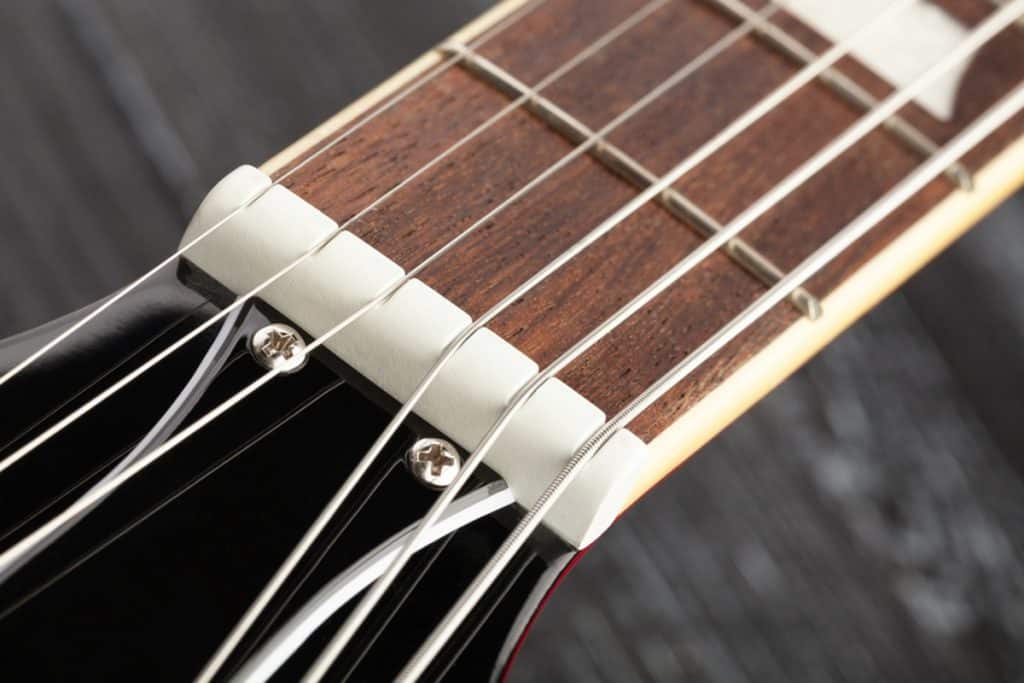
Fortunately, this is relatively easy as the nut is readily apparent to any eye that looks at a guitar. Focus your gaze on the guitar’s headstock area and you’ll be able to identify the nut.
The nut is placed at the very top of the fretboard where the fretboard and headstock meet. It’s usually a fairly thin piece of material that sits across the entire width of the fretboard.
More often than not, the nut of the guitar will usually be colored either black or a shade of white.
What Purpose Does The Guitar Nut Serve?
Discovering the purpose of the guitar nut might require you to take a look at your trusty stringed companion. Do you notice how all of the strings remain in line until they sprout off toward the tuning pegs?
Making such an observation will provide you with some context clues to aid you in this explanation. For the string to properly vibrate to a specific pitch, a set number of variables need to be in place.
The biggest variable is the string needing to be lifted away from the fretboard. Otherwise, the string just will not ring out clean and properly like you would expect it to.
In some sense, you can experience this firsthand when changing strings. Despite being slackened, a string touching the fretboard kills any sustainable resonant vibration.
However, if the nut was not in its location when tuning the string to pitch, you’d have another problem. The strings would fan out too early toward the tuning pegs, making lower fret regions even more difficult to play.
So, effectively, the nut serves as a sort of retainer to keep all of the strings in place. After all, the nut does have individual slots for each string to be properly seated.
But there is a bit more magic at work here that is required for the guitar to actually be playable. There is, after all, the question of actually getting the strings to stay in place.
Even if you’re only vaguely familiar with guitars, you’ve probably noticed something distinct about headstock designs. Typically, headstocks tilt away from the linear direction of the headstock.
This is done so that the string tension is properly applied to a specific location, which would be the nut. By doing so, the strings are prevented from jumping from the nut slots when playing open strings.
You might be thinking to yourself that not every guitar has a headstock that tilts away from the fretboard. And while the tilt is mostly seen on headstocks with a 3+3 tuning peg design, 6-in-a-line is not exempt.
Despite being in the same linear direction as the fretboard, they have a specific design to compensate for this angle. The tuning pegs actually sit behind the nut at an angle away from the fretboard.
In some cases, the entire headstock is placed at an angle behind the nut. This provides the same functionality regarding the focus of string tension to the nut’s location.
There’s also another major reason headstocks are tilted in this manner. Guitars are designed so that the strings only vibrate within a certain area of the guitar.
Such a design provides the ability to tune the guitar to pitch, with all notes reflecting their intended pitches. In other words, it’s why every fret pitch is the same from guitar to guitar (in the same tuning).
This distance is referred to as the “scale length” of the guitar, spanning from the nut to the string saddles. Like the nut, the saddles serve a similar purpose in providing a retaining fulcrum point.
What’s The Reasoning Behind Its Name?
The actual origin behind why the guitar nut is named as such remains obscure. But, like the evolution of most languages, we can assume that the English term likely came from another language.
One of the most likely explanations is that it may have come from the German word “nute”. The word translates to “groove” in English, which effectively describes the nut’s string slots.
Throughout history, “nute” has been used to describe both nuts and string saddles. But given that they both have very similar functions, this distinction makes logical sense.
What Are Guitar Nuts Made From?

Guitar nuts are made from a wide variety of different materials. Some materials have been more popular during different eras of time, while others are quite rare.
For the most part, you’ll find that guitar nuts are made from animal bone, synthetic materials, or metallic materials. Let’s take a closer look at each kind of nut material and weigh out some of its advantages and disadvantages.
Bone
For centuries, animal bone has been considered the optimal material for use in both guitar nuts and saddles. And while this might make some people cringe, it actually makes quite a bit of sense.
Bone has been found to be a material that maintains the sustain of a ringing note. It also ensures that, if an animal is to die, use can be found for all of its parts.
Aside from its ability to maintain sustain, bone is quite easy for luthiers to work with when cutting string slots. It also has the ability to self-lubricate, protecting the string’s tuning when the string is bent.
Because bone is a natural material, the consistency of its hardness is not always evenly dispersed. All bones are unique and the same guitar models can be affected by the consistency of their bone nuts.
Bone nuts can still be found today though manufacturers are more frequently leaning toward alternative materials. They are especially common on vintage guitars, as well as (typically but not always) higher-end modern models.
Ebony
It might seem strange to have a wooden nut, but ebony is a viable option for a guitar nut. The wood is incredibly dense, providing both functionality and an aesthetic flair due to its blackened color.
One of the major benefits of ebony is that it is rather inexpensive compared to other options. Despite its affordability, it still provides plenty of note sustain needed for a playable guitar.
Some of its drawbacks include the fact that it does have inferior sustaining abilities compared to bone. Because it is wood, an ebony nut also has a chance of becoming a bit soft over time.
Plastic
Putting anything related to plastic on a guitar might seem like a desecration to certain guitar purists. After all, it is one of the biggest banes contributing to the many large-scale issues that humanity faces today.
But sometimes, it’s not the most practical decision to put a bone nut on a guitar built for a beginner. Quite frankly, beginner guitars are the most commonly sold, which would equate to a large number of bones being used.
Which of the two evils is the lesser evil in your book? For manufacturers, plastic is a clear choice, with the added benefit of lower cost per unit.
This lower cost, in turn, reflects back onto the price that the consumer pays when they purchase a guitar. As such, it ensures that guitars are accessible and can be acquired at every budget level.
By no means does a plastic nut have the same resonant qualities that bone provides to a guitar. But, for any beginner or light hobbyist, a plastic nut should be more than sufficient.
In fact, it’s not all that uncommon to find plastic nuts on guitars priced accordingly for intermediate players. If plastic is an issue for you, make sure you read the spec sheet on a guitar before purchasing.
Plastic nuts are also quite brittle in nature and have the ability to chip or break upon impact. Plus, not all plastic nuts are created equally with regard to their overall hardness.
If you can choose, it’s best to opt for a plastic nut that is both harder and more dense. Softer plastic nuts can be affected by normal string wear over time, which causes its own set of issues.
Tusq
One of the most popular synthetic nuts you’ll find being used on guitars is made from a material called Tusq. This man-made material is made by the company, Graph Tech, and closely emulates the characteristics of bone nuts.
One of the biggest debates in the guitar world has been whether bone is better than Tusq. For most people, there isn’t much difference.
And while that might seem like a drawback, remember that we’re discussing the gold standard of nut material. If something is just as good as the best, without involving animals, surely this has to be a good thing.
Fortunately, many manufacturers have held this sentiment, frequently featuring them on acoustic and electric guitars. But aside from its moral benefits, Tusq actually has a huge benefit over bone nuts.
Remember how we mentioned that bone density can vary throughout the nut? Synthetic manufacturing ensures that the density consistency of the Tusq nut remains balanced and even without unpredictable natural variables.
Despite being a synthetic material, it’s definitely not as inexpensive as a plastic nut would be. However, for the price and constant availability, Tusq remains one of the best options for a guitar nut.
Fossil Ivory
If bone isn’t readily available, fossil ivory is generally considered to be an equal natural material for guitar nuts. But, to be fair, because of its fossilized nature, these nuts are even more rare.
There are actually some benefits to fossil ivory compared to that of a standard bone nut. These nuts are typically far more dense and harder than bone is, making for exquisite sustain.
The obvious drawback that goes hand-in-hand with this hardness is that it can be difficult to work with. Generally, these nuts are likely only reserved for extremely luxurious guitars because of their price and sourcing difficulties.
Graphite
Another very popular synthetic material option for guitar nuts is graphite. However, it’s important to note that not all graphite nuts are created equally.
For starters, graphite nuts have much of the same properties as what can be found with bone nuts. The biggest selling point of graphite nuts is that they are self-lubricating and maintain excellent tuning stability.
Graphite has been commonly used for a number of different applications requiring lubrication. Some apply it to piano pedals to eliminate squeaks and others rub it onto guitar nuts for lubrication.
Because of its lubricating nature, a graphite nut will provide a foundation of much lower friction than other materials. This is especially ideal for any guitar equipped with a tremolo bridge.
One of the only drawbacks is that graphite nuts cannot be found in any other color but black. But if aesthetics aren’t important to you, a graphite nut will serve you well for a long period of time.
Metal
At some point during the 1970s, manufacturers began using metallic materials to craft the guitar nut. One of the most famous examples of a guitarist using a metallic nut is the Grateful Dead’s Jerry Garcia.
The most common metal used throughout history has been brass, which has its pros and cons. For starters, it is a fair deal more expensive to source than a nut made of synthetic material.
These nuts actually provide a bit of a focus on the treble range of the guitar’s tone, sometimes enhancing clarity. They are also quite durable due to the fact that it is more resistant to wear than any other material.
But, like the fossilized ivory, brass nuts are obscenely difficult for luthiers to work with when cutting string slots. Eventually, these nuts became phased out over time because of this very aspect.
Are There Any Variations Of The Guitar Nut?
Aside from the traditional nut that you’re probably familiar with, there are some varieties out in the wild. Whether you encounter them depends primarily on the guitar and manufacturer you choose to go with.
The locking nut variety is probably one of the most common, which is used in tandem with a tremolo system. Floyd Rose tremolos are the most notable example of this, which lock the strings in place for better tuning stability.
If you opt for a Music Man guitar built by Ernie Ball, you might encounter a compensated nut. These nuts are similar to compensated saddles, featuring staggered slots to aid in greater tuning accuracy.
Another uncommon type of nut is known as a “zero fret”, featuring an extra fret at the open position. Rather than using the saddles for string height, a zero fret nut is usually adjustable and located behind the fret.
Roller nuts are also available, which house the strings on bearings to decrease the friction within the slot.
Will My Guitar Nut Last Forever?
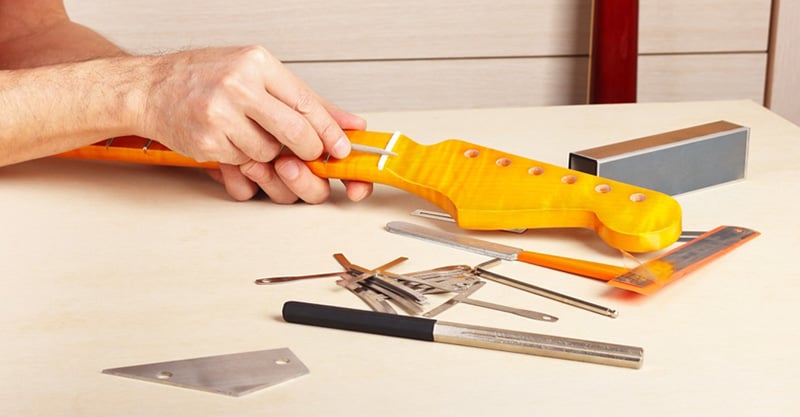
Unfortunately, a guitar nut will not likely last forever but there’s a chance it could live a few decades. Over time, nuts wear out and some adjustments regarding the string slots need to be made.
One common issue is that the strings seat too low, causing string buzz. Fortunately, a skilled luthier may be able to add the necessary material without replacing the nut.
What Is A Guitar Nut, Final Thoughts
Who would have thought that a small, unassuming part of a guitar could be so integral to its primary function? It goes to show that the most seemingly unimportant part can be more vital than what is often given attention.
Do you have a newfound appreciation for the guitar nut now that you know what it actually does? If anything, you might marvel at how the guitar is only so amazing because of the sum of its parts.
Side note, do you want to learn to play guitar songs the easy way? Learn how here – results are guaranteed!