

Guitar Aficionado is supported by readers. If you buy something after clicking on one of our links, we may get an affiliate commission from that & it won’t cost you anything.
Trying to make sense of terminology used by guitarists can be an incredibly daunting task for any beginner. Sometimes, the words being used do not always make the most sense with regard to their intended meaning.
Such is the case with the word “lick”, which is enough to leave any guitarist scratching their head in confusion. If you’re going to call yourself a competent guitarist, it’s time to learn the meaning and create your own licks.
Table of Contents
Do I Have To Lick My Guitar?
If you’re like me, coming across the word “lick” in a guitar magazine opened a gateway to mental imagery. Surely the guitar greats aren’t living their lives licking their guitars every day…right?
Well, maybe not in the sense that you might initially think. Using lick to mean punishing a guitar isn’t exactly synonymous either, even if used in the positive “that’s sick” manner.
Is It A Guitar Lick Or A Riff?
Flip through any guitar magazine and you’ll inevitably come across musical passages labeled as licks. This is going to be the biggest clue you can use to your advantage.
Licks can be simply defined as musical passages, but this can create some confusion with the word “riff”. Sometimes, the words can be used interchangeably, which doesn’t provide any help for unsure beginners.
Riffs are generally musical phrases that repeat themselves and serve as a fundamental structure to the song. You’ll find riffs being employed in just about every genre that has a guitar being utilized.
Some of the most famous rock bands in history have created timeless hits built on the use of riffs. Led Zeppelin is the most iconic, and almost every song of theirs has notable riffs.
Licks, on the other hand, are usually not repeated and don’t have the same foundational importance as a riff. But, the caveat here is that, sometimes, licks can be repeated and have foundational importance.
Both riffs and licks can be comprised of chords and single-note passages. The distinction between riffs and licks often comes by means of how vital it is to the song’s underlying foundation.
Are you confused yet? Don’t worry, placing these words in the context of everyday language will help to clear things up.
Decoding Musical Conversation
Have you ever walked into an open mic session and witnessed the true magic of competent musicians working together? Even if they have never played together, these musicians can play together as if they have been together for years.
To the average non-musician listener, the ability to do this is often a bit confusing. But for somebody with an attentive ear, you might notice that there seems to be some underlying language.
In the setting of a live performance, each musician is essentially having a conversation amongst themselves. It sounds like a New Age cliche, but the language they are speaking is music.
Like all languages, music tends to follow some of the same rules and syntax we use in our everyday speaking. Learning how to speak the language is crucial for any musician wanting to harness their individual musical identity.
To boil it down, a song’s foundational form could be considered the topic of conversation being had. The chord progression and rhythm help to determine the mood surrounding this topic of conversation.
But, like any topic of conversation, words need to be said for it to actually be considered a conversation. Otherwise, the topic is just a mere concept or idea.
Sometimes, phrases come up that help to keep the conversation moving forward despite their repetitive nature. These messages (known as riffs) provide something that people can readily identify with.
And though a musical conversation can be built from riffs alone, a little bit of elaboration makes things interesting. How else would you be able to communicate the subtle mental minutia you have regarding the topic at hand?
It’s these sentences that are generally considered to be licks. They might not always be repeated but they do convey quite a bit more than is readily apparent otherwise.
Where Are Licks Most Commonly Found?
The previous analogy is excellent for understanding riffs and licks in an everyday manner. But how does this translate to the actual music being played?
We’ve already discussed how riffs are generally repeated as a foundational aspect of the song. Licks, on the other hand, or most commonly found in guitar solos or any other short passage.
Guitar solos are an excellent example to use primarily because it is as if the guitarist is giving a monologue. Like any speech, an idea is conveyed by means of separate sentences which are usually segmented into paragraphs.
It is these separate sentences that you’ll want to give special attention to when you’re looking for licks. This is also the reason why featured licks in guitar magazines are typically just short musical sentences.
Keep in mind that licks can occur anywhere in music, even during sung verses. Guitar solos are just the most common as they are built from individual licks rather than riffs.
Let’s take a closer look at some songs that have some notable licks so you can develop a concrete understanding.
Led Zeppelin – Whole Lotta Love
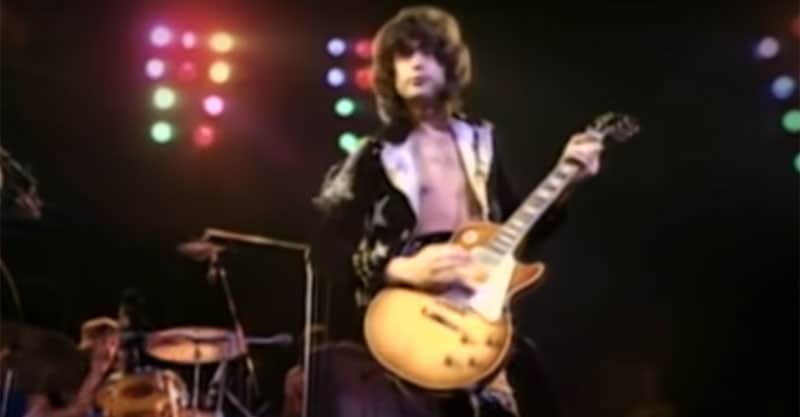
To begin, let’s start with a song that features both prominent riffs and licks throughout its entirety. The song begins with a riff that serves as the foundation that the rest of the music is based upon.
There really isn’t much deviation outside of the main riff during the majority of the song. While the entire main riff could be considered a repeated lick, his actual licks begin with the guitar solo.
Notice that his solo seems to be comprised of individual sentences, much like he has having a conversation. His introduction sentence seems to provoke a question, with the following sentence providing a reply.
And even though there seems to be a melodic similarity between these two sentences, the notes are inherently different. The entire solo progresses in line with this approach of building sentences from licks to create a larger statement.
Dire Straits – Sultans Of Swing
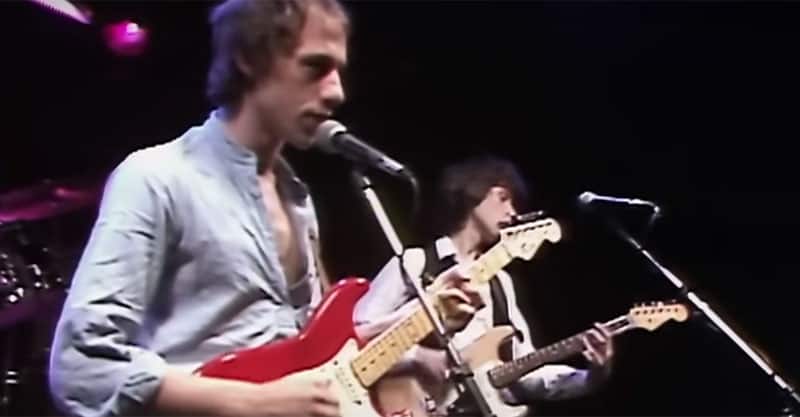
Let’s step it up a notch and look at Sultans Of Swing. This is a track that is filled to the brim with unique licks.
From the very beginning, just after the song makes its brief introduction, the listener is greeted with a lick. This lick serves as a quick statement of foreshadowing to convey the overall tone and feel of the song.
Progressing through the song, Mark Knopfler tends to add a unique lick between almost every line he sings. This is done as a sort of call-and-response and helps to add a sense of punctuation to his lyrics.
Later in the song, Knopfler repeats some of his licks to serve as a functional melody, especially during the choruses. The distinction making it a lick (and not a riff) is that it is only repeated in certain instances.
While these are just a few examples, the entire song seems to function in this manner. The song’s guitar solo is also built primarily using sentences made of individual licks, similar to Whole Lotta Love.
Phish – Ghost (Live at Northerly Island, Chicago, IL 7/20/2014)
It’s easy to study compositional music to understand licks, but using them in an improvised setting is another ballgame. Such music relies upon the creation of licks made in real-time in conversation with the other performing musicians.
This approach has been the fundamental aspect of jazz music since the start of the genre. The improvised mentality has found its way into rock music, with Phish being one of the foremost masters of improvisation.
They will often play the songs as they were written (often featuring riffs and licks). The distinction is that there is generally a section where things are unplanned, such as this Ghost from 2014.
This might not be the best example of Phish to share (there are 40 years of show recordings). However, it is one that I witnessed with my own eyes that remains unforgettable to this day.
Throughout this cut, you’ll hear a wide range of different licks, some of which actually turn into riffs. Because of the band’s in-tune nature, they are able to communicate and modulate to different keys during the moment.
You’ll even notice how, in this cut around the 5-minute mark, the song transitions from minor to major tonality. Throughout the jam, little licks are being used to establish foundational riffs.
If you keep your ears open, you’ll realize that the entire band is essentially exchanging licks with one another. This is what any competent musician should ultimately aim for in their studies.
How Can I Learn Guitar Licks?
By now, you’ve probably started to ascertain the importance that licks can play in music. You’re probably also aware that, to be able to speak the language, you must first learn the language.
There are a few different ways you can go about learning guitar licks. The most popular is by taking guitar lessons, usually by watching online video lessons covering a specific song.
This has the benefit of being able to see exactly how different licks are being played. Plus, you can rewind them and watch them as many times as needed.
Many people like to learn licks by means of guitar tabs, whether it be on the internet or in magazines. These are often readily available, making them a viable choice in a pinch.
Of course, there are some drawbacks to going these routes. The first drawback is that the transcriptions might not be accurate.
With written tablature especially, it can be difficult to understand the underlying rhythm of the lick. Without the actual recording complementing the lick, you’ll never be quite sure you’re playing it correctly.
By far the best way to learn licks is by learning them using your ears when listening to the song. Slow the songs down so you can hear each note clearly and write your own transcription.
This will train your ears to be more accurate and precise and will build your confidence as a musician. You’ll surprise yourself when you can play back by ear what your friend just played a few seconds before.
Learning by ear is definitely a time-consuming and laborious process. But it does ensure that you’ll be able to walk into any room and play with any musician.
There are a number of programs available that allow you to adjust speed, modulate keys, and create loops for practice. Even video hosting sites like YouTube will allow you to adjust the speed of the video playback.
Using the ears to learn the guitar is a tradition that has been followed by all of the greatest musicians. Unlike many of the greats, you get to enjoy the convenience of modern technological capabilities during the process.
How Do I Create My Own Licks?
So, you’ve learned some licks…now what? Well, you’ve probably realized that licks you’ve learned from one song won’t typically work in another song.
Each song is uniquely different and you generally won’t be able to play a lick note-for-note without changing it. Even if the song is built from the same chords, there’s a chance a stock lick won’t cut the mustard.
What you should be doing with licks is playing around and changing them. Try omitting certain notes, substituting other notes, and maybe adding an embellishment here or there.
Another great method is to jam along to a progression on a loop pedal and see what happens. Try to create your own call-and-response statements.
Always be sure to use and follow your ears!
What Is A Guitar Lick, Final Thoughts
Every great guitarist is known for their guitar licks. The lick is steeped in the guitarist’s musical personality, acting as a musical thumbprint.
When you create your own licks, make sure that your own identity is present. Your licks are what makes you instantly recognizable to anyone who is familiar with your musical style.
Side note, do you want to learn to play guitar songs the easy way? Learn how here – results are guaranteed!